Bona FlexiSand DCS Buffer: Discs, Screens, Grit Sequence
By Matt Lipman · Reviewed by Professional Sandpaper Guide editorial team · Updated May 1, 2026 · NWFA-aligned
Affiliate & relationship disclosure
Matt Lipman is CEO of Capstone Holdings Corp. (NASDAQ: CAPS) and a board member of Virginia Abrasives. He discloses this relationship for full transparency in our reviews.
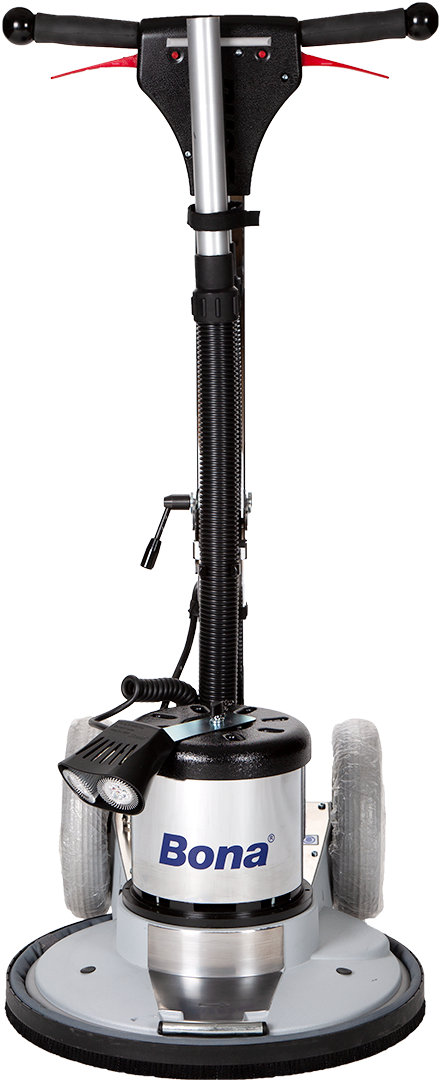
The Bona FlexiSand DCS is a 16-inch buffer designed for screen-and-recoat work, between-coats sanding, and — with the Power Drive accessory plate — random-orbital sanding down to bare wood. It takes 16-inch screens and pads on the standard driver, six 5-inch discs on the MultiDisc plate, and a quad-head sanding system on the Power Drive. This guide covers the abrasive sizes, the grit sequence for each application, quantity planning, and how the FlexiSand fits alongside drum sanders like the Silverline SL-8 and Clarke EZ-8.
Bona FlexiSand DCS Specifications
| Specification | Detail |
|---|---|
| Motor | 1.5 HP, dual capacitor |
| Power | 115V / 15 amp / 60 Hz |
| Pad RPM | 175 RPM |
| Pad capacity (standard driver) | 16 inches — accepts 16" screens and pads |
| Weight | 102 lb (with pad driver) |
| Gearbox | 10:1, all-steel, sealed and lubricated |
| Power cord | 25 ft, 14/3 gauge |
| Handle | Hydraulically adjustable height; foldable for transport |
| Dust collection | Integrated dust channel + floating dust skirt; pairs with Bona DCS vacuum systems |
Specs verified against Bona’s published technical data sheet for the FlexiSand DCS Buffer (US 115V model). The European FlexiSand 1.9 (230V, 1.9 kW) is a different machine — confirm voltage before ordering parts internationally.
Why the FlexiSand Matters to Floor Refinishers
A drum sander cuts. A buffer blends. The FlexiSand is the second machine — the one that erases drum-pattern scratches, prepares the floor for finish, scuffs an existing coating for a recoat, and (with the Power Drive accessory) doubles as a swirl-free random-orbital sander.
Skip the buffer step and you get drum-pattern ghosting under finish. Most refinishing complaints — “I can see lines under the poly when the light hits it right” — trace back to a missing or rushed buffer pass. The 175 RPM pad speed on the FlexiSand is fast enough to blend the field with the edged perimeter and slow enough not to burnish the wood closed before stain.
The DCS variant ships with an integrated dust shroud and pairs with Bona’s DCS vacuum line for near-dust-free operation. That matters on occupied homes and on dust-sensitive species like white oak where airborne tannin dust stains adjacent surfaces.
FlexiSand Abrasive Sizes — Three Drive Systems
The FlexiSand chassis accepts three different drive plates. Each takes a different abrasive size and fits a different stage of the job.
Standard 16-inch pad driver (ships with the machine)
This is the default plate — a single 16-inch hook-and-loop driver. Use it for:
- 16-inch sanding screens in 60, 80, 100, 120, 150, 180, and 220 grit. Silicon carbide is the standard abrasive for screens. Use these for screen-and-recoat, between-coats poly, and the final blending pass after a drum sander.
- Maroon, red, white, and tan buffing pads for waxing, polishing, and final dust knock-down before finish coat.
- Tampico brush for grain-cleaning hard-to-reach pattern floors.
MultiDisc plate (sold separately)
The MultiDisc holds six 5-inch hook-and-loop discs that spin independently of each other on a planetary drive. The independent rotation cancels out swirl marks that a single 16-inch screen would leave on softer or figured woods.
Use the MultiDisc for:
- Final fine-sanding passes (80, 100, 120 grit mesh) before stain or finish
- Floors with figured grain (tiger maple, quartersawn oak) where rotary swirl would telegraph
- Light cuts on engineered floors with thin wear layers — the planetary motion is gentler
Power Drive plate (sold separately)
The Power Drive is the accessory that converts the FlexiSand from a buffer into a sander. It is a quad-head gear-drive that delivers random-orbital sanding to bare wood while reaching within 1-1/2 inches of walls — much closer than a drum sander, which dramatically reduces edger work.
Power Drive uses:
- Buffer plate — 16-inch hook-and-loop for screens (same as standard driver)
- Multi-disc — four to six 6-inch discs (spec varies by model year)
- Diamond discs — for concrete, terrazzo, and other hard-substrate prep
- Wire brush kit — hook-and-loop wire brushes for textured/wire-brushed finish looks
- Steel plate, Tynex brushes, dust skirts, and 15-lb weight kits for aggressive cuts
Bona’s recommended sequence for the Power Drive on bare wood starts at 40 to 60 grit with the weight kit installed for cutting power, progresses through 80 to 100 grit (weights removed — the lighter touch prevents motor overload on fine grits), and finishes with fine mesh for swirl-free preparation.
Important operating note: when sanding bare wood with the Power Drive, keep the handle as close to 90 degrees vertical as possible. Tilting the handle changes weight distribution and produces uneven cuts — a habit that drum-sander operators have to unlearn when they first switch to the Power Drive.
Grit Sequence for Each FlexiSand Application
Screen-and-recoat (existing finish, no bare wood exposed)
The standard NWFA-aligned screen-and-recoat sequence on the FlexiSand:
| Pass | Grit | Purpose |
|---|---|---|
| 1 | 120-grit 16" screen | Scuff existing finish for adhesion |
| 2 | 150-grit 16" screen | Refine 120 lines, even the texture |
| 3 (optional) | 220-grit 16" screen | Show-area kiss before finish |
The screen should not cut through the existing finish to bare wood. If you see raw wood after the 120-grit pass, the existing finish was already worn through and the floor needs a full sand-and-finish, not a screen-and-recoat. Stop and reassess.
Between coats of polyurethane
One pass with a 220-grit 16-inch screen between each coat of oil-based polyurethane. For water-based polyurethane, the same 220 grit works — keep the touch light and vacuum thoroughly before recoating because water-based finish dust gums up easily. Never sand past 220 between coats: finer grits close the surface and the next coat will not bond properly.
Bare-wood sanding with the Power Drive
For full bare-wood refinishes using the Power Drive plate (instead of, or alongside, a drum sander):
- 40-60 grit discs — first pass with the 15-lb weight kit installed. Replaces the 36-grit drum pass on jobs where a drum is impractical (small rooms, second-floor jobs, stairs adjacent to landings).
- 80 grit — remove the weights. The lighter touch prevents motor strain on fine grit.
- 100 grit — final cut for stain-ready or water-based polyurethane jobs.
- Fine mesh (120 grit equivalent) — swirl-free finish prep, blends with edger work.
Some contractors run the Power Drive start-to-finish on smaller residential jobs and skip the drum sander entirely. The trade-off: slower removal on heavy old finishes, faster overall workflow on jobs under 500 sq ft because there is no edger-blend step.
How Many Screens or Discs to Buy
Buffer screens and 5-inch mesh discs last longer than drum sheets because the cut is much lighter. Plan accordingly.
Screen-and-recoat: 500 sq ft
| Grit | 16" screens needed | Notes |
|---|---|---|
| 120 | 2 | Add one extra if the existing finish is heavy |
| 150 | 2 | Standard quantity for refining 120 lines |
| 220 (optional) | 1–2 | Show areas only; not always needed |
Total: 5 to 6 screens for a 500 sq ft screen-and-recoat. Scale linearly: 8–10 screens for 1,000 sq ft.
Between-coats sanding: 500 sq ft
Budget 1 to 2 220-grit screens per coat. A single 220-grit screen will handle 500 sq ft if the floor is clean and the cut is light. Buy two and save the second for the next coat.
Bare-wood Power Drive sanding: 500 sq ft
| Grit | Disc/screen quantity |
|---|---|
| 40 or 60 (Power Drive discs) | 3–4 sets |
| 80 | 2–3 sets |
| 100 | 2 sets |
| Fine mesh (120 equivalent) | 1–2 sets |
“One set” equals however many discs your Power Drive plate holds (typically four 6-inch discs). Always buy one extra set per grit. Hard species (hickory, hard maple, jatoba) wear discs faster — add another set on those jobs.
Species & Janka Hardness Reference
FlexiSand cut speed and disc life vary by species hardness. The same Janka reference table that governs drum-sander grit choices applies here:
| Species | Janka (lbf) | FlexiSand notes |
|---|---|---|
| Eastern white pine | 380 | Use MultiDisc, not standard screen — single-rotation marks show on softwoods |
| Cherry | 950 | Burnishes easily; keep moving, do not dwell |
| Black walnut | 1,010 | Softer pores show screen marks — MultiDisc preferred for final pass |
| Red oak | 1,290 | Standard sequence works; calibration baseline for most published specs |
| White oak | 1,360 | Same sequence as red oak; tannin dust requires DCS-rated vacuum |
| Hard maple | 1,450 | Burnishes if you stop moving; budget extra screens |
| Hickory | 1,820 | Add 30% to disc/screen budget; ceramic-grain mesh lasts longer |
| Brazilian cherry (jatoba) | 2,350 | Use ceramic mesh discs; doubles abrasive life on dense exotics |
Engineered hardwood warning: with a wear layer under 3 mm, never run the Power Drive below 80 grit. Use the standard 16-inch driver or MultiDisc only — the Power Drive’s aggressive cut at low grits will burn through veneer fast.
If you are choosing between this and a rectangular orbital, the Square Buff, or American Sanders OBS-18, takes 12×18 sheets and reaches square into corners, which a 16-inch rotary cannot.
FlexiSand vs. Drum Sanders and Edgers
The FlexiSand is not a replacement for a drum sander on full refinish work — it is a complement. How it fits in the job sequence:
- vs. Silverline SL-8 / Clarke EZ-8 (drum sanders): Drum sanders cut. The FlexiSand finishes. On a typical refinish, the SL-8 runs 36 → 60 → 80 → 100 in the field, the edger handles the perimeter, and then the FlexiSand with a 120-grit screen blends the field-to-edge transition. Skipping the FlexiSand step is the most common cause of visible scratch ghosting under finish.
- vs. Clarke Super 7R (edger): The edger handles the 6-inch perimeter the drum cannot reach. The FlexiSand’s standard driver does not get closer than ~6 inches to the wall either. The Power Drive plate gets within 1-1/2 inches — the only configuration that meaningfully reduces edger time.
- vs. Lagler Hummel (professional belt sander): The Hummel cuts more aggressively than any drum the FlexiSand is paired with. On commercial jobs and old painted floors, contractors run Hummel for the cut and FlexiSand DCS for the blend. On residential jobs the SL-8 or EZ-8 paired with the FlexiSand is the standard rental-scale combination.
- FlexiSand alone (with Power Drive) for small jobs: on rooms under 300 sq ft, second-floor jobs where moving a 200-lb drum is impractical, and stairs/landings, the Power Drive can run start-to-finish. Slower cut on bare wood than a drum, but no setup change between cut and finish passes.
For machine-specific sheet sizing on the drum sanders, see the Silverline SL-8 guide, Clarke EZ-8 guide, and Clarke DU-8 guide. For the perimeter machine, see the Clarke Super 7R edger guide.
Common Problems and Fixes
Swirl marks under finish on softer woods
Standard 16-inch screen on a 175-RPM rotary motion leaves a single rotational pattern that telegraphs through finish on pine, walnut, and figured maple. Fix: switch to the MultiDisc plate for the final two passes. The independent 5-inch disc rotation cancels the directional pattern.
Burnished spots that will not take stain
Pad dwelt in one place too long, friction closed the wood grain. Re-screen at 100 grit to reopen, then proceed to 120 and finer. Train operators to keep the machine in continuous motion — never let it sit running on one spot.
Screen tears mid-pass
Screen wrapped around debris (a finish chip, a nail head, a staple). Inspect the floor before each pass. After 80-grit drum work, vacuum thoroughly before mounting the FlexiSand screen.
Power Drive bogs down on first pass
Either the weight kit is installed at too high a grit (remove weights at 80 and finer), or the previous drum cut was insufficient. The Power Drive is not a Hummel substitute for stubborn finishes — pre-cut with a drum or Hummel first.
Dust skirt drags or curls
Floating dust skirt clogged with finish residue. Brush clean between rooms. On heavy old varnish, expect to wipe the skirt every 200 sq ft.
Where to Rent or Buy the Bona FlexiSand
The FlexiSand DCS is less common in the rental fleet than drum sanders. Most professional flooring contractors own the FlexiSand outright because it is used on every job. Owned-machine economics make sense after roughly 30 days of use.
Rental availability:
- Local flooring supply stores — most likely source. Call ahead.
- Sunbelt Rentals and United Rentals — limited inventory; usually requires reservation.
- Home Depot and Lowe’s — typically do not carry the FlexiSand. Big-box rental fleets stock cheaper buffers without DCS dust containment.
The Power Drive accessory plate and the MultiDisc plate are sold separately from the base machine. Most rental shops stock the standard 16-inch driver only — confirm plate availability when reserving.
Where to Buy 16” Screens, 5” Mesh Discs, and Power Drive Discs
Virginia Abrasives manufactures 16-inch silicon-carbide sanding screens in 60, 80, 100, 120, 150, 180, and 220 grit, plus 5-inch mesh discs and Power Drive-compatible discs. Available on Amazon through the Virginia Abrasives store.
Shop Virginia Abrasives on Amazon
16-inch screens, 5-inch mesh discs, and edger discs for floor refinishing.
Shop Virginia Abrasives →Amazon Associate disclosure: we earn from qualifying purchases at no extra cost to you.
For Bona-branded abrasives (siafast 5-inch discs, Bona-specific mesh), order through Bona’s direct dealer network or specialty flooring suppliers. Big-box stores rarely stock 16-inch screens above 150 grit — order 220 grit ahead of time if you need it.
Frequently Asked Questions
What size discs and screens does the Bona FlexiSand take? ▼
The standard 16-inch pad driver accepts 16-inch screens and pads. The MultiDisc plate (sold separately) holds six 5-inch discs that spin independently. The Power Drive plate (sold separately) accepts a 16-inch buffer plate or four 6-inch sanding discs, plus wire brush and Tynex pucks for textured finishes.
What grit sequence does Bona recommend for screen-and-recoat with the FlexiSand? ▼
For screen-and-recoat over an existing finish, run a 120-grit 16-inch screen first, then a 150-grit screen. Add a 220-grit pass for high-show areas. Between coats of polyurethane, a single 220-grit screen pass is enough — never sand finer than 220 between coats or the next coat will not bond.
Can the Bona FlexiSand sand bare wood? ▼
Only with the Power Drive plate accessory installed. The standard pad driver is for screening and buffing finished floors. The Power Drive turns the FlexiSand into a quad-head random-orbital sander capable of running 40 to 100 grit on bare wood, sanding within 1.5 inches of walls and dramatically reducing edger work.
How many 16-inch screens do I need for a 500 sq ft screen-and-recoat? ▼
Budget two 120-grit screens and two 150-grit screens for a 500 sq ft room on the FlexiSand. Add one 220-grit screen for show-area refinement. Screens last roughly twice as long as drum sheets because the cut is light. Buy one extra of each grit as insurance.
Is the FlexiSand a replacement for a drum sander? ▼
No on full refinishes over 500 sq ft. The Power Drive accessory makes the FlexiSand capable of bare-wood sanding, but cut speed at low grits is slower than a drum. On small jobs (under 300 sq ft, stairs, second-floor rooms) or on screen-and-recoat work, the FlexiSand can run start-to-finish.
Related Guides
- 80 Grit vs 100 Grit Sandpaper for Floors— 80 vs 100 grit final pass: 100 for water-based or stain, 80 for oil-based clear.…
- Best Sanding Sheets for Clarke DU-8 Drum Sander— Clarke DU-8 sandpaper: 8×19.5 inch sheets. Loading, troubleshooting, rental insp…
- Best Sandpaper for Hardwood Floor Refinishing— Best sandpaper for hardwood floor refinishing: Virginia Abrasives vs Norton vs 3…
- Clarke EZ-8 Sandpaper Size Guide: Both Versions, Specs— Clarke EZ-8 sandpaper: older clamp-bar uses 8×19.5 sheets, newer expandable drum…
- Clarke Super 7R Edger: Specs, Disc Sizes, Variable Speed— Clarke Super 7R edger guide: 7-inch discs, 7/8 vs 5/16 center hole, variable spe…
- Floor Sanding Edger Discs 7-Inch: VA vs Norton vs 3M— Best 7-inch edger discs compared: VA, Norton, 3M by stage. PSA vs hook-and-loop.…
- Drum Marks, Swirl Marks, Scratches: Floor Sanding Fixes— Fix common floor sanding problems including drum marks, swirl marks, and scratch…
- How to Sand Hardwood Floors with a Rental Sander— Sanding hardwood floors with a rental drum sander: NWFA grit sequence, dust and …
- Lagler Hummel Belt Sander: Belt Sizes, When It's Worth It— Lagler Hummel guide: 7-7/8 × 29-1/2 belts, rental inspection, honest when-it-jus…
- Free Sandpaper Grit Chart PDF: Every Grit, Every Material— Printable sandpaper grit chart PDF — which grit for wood, drywall, metal, paint.…
- Sandpaper Types: Aluminum Oxide vs Ceramic vs Zirconia— Aluminum oxide, silicon carbide, ceramic, and zirconia compared. Which abrasive …
- Silverline SL-8 Sandpaper: 8×20-1/8 Size Guide— Silverline SL-8 slotted drum takes 8×20-1/8 sheets; the hook-and-loop drum takes…
- Sandpaper Backing, Bonding & Coating: What They Mean— Beyond grit: how sandpaper backing (paper vs cloth), bonding resin, and open vs …
Shop Virginia Abrasives on Amazon
Drum sander sheets, edger discs, polishing pads, grit kits. U.S. manufactured. Free Prime shipping on most items.
Browse Virginia Abrasives →