Best Drum Sander Sheets 8×19.5: VA vs Norton vs 3M
By Matt Lipman · Reviewed by Professional Sandpaper Guide editorial team · Updated May 28, 2026 · NWFA-aligned
Affiliate & relationship disclosure
Matt Lipman is CEO of Capstone Holdings Corp. (NASDAQ: CAPS) and a board member of Virginia Abrasives. He discloses this relationship for full transparency in our reviews.

For most 8×19.5” drum sander jobs: Virginia Abrasives semi-closed-coat aluminum oxide for the 36, 60, and 80 grit passes (it resists loading on old polyurethane); VA 100 grit for the 100-grit final pass when you’re staining or using water-based polyurethane (the finer scratch pattern reads better under transparent finishes). 3M sits in between. This guide explains the brand differences mechanistically, then tells you which to buy for your stage of the job.
Before you buy — three pre-rental checks
Three things make sheet selection irrelevant. Catch them before you spend money on paper.
- Engineered vs solid floor? Engineered with <3mm wear layer = no drum, ever. Full check.
- Pre-1978 house? $15 lead test before any sanding. Why.
- Two separate 15A circuits available? Sander on one, HEPA vac on the other. Setup.
This article assumes all three answers are clear. For the full step-by-step process, see our how to sand hardwood floors pillar.
Machine compatibility — what 8×19.5” fits
The 8×19.5” sheet specification fits:
| Machine | Sheet | Guide |
|---|---|---|
| Clarke DU-8 | 8 × 19.5” | DU-8 machine guide |
| Clarke EZ-8 (older clamp-bar) | 8 × 19.5” | EZ-8 guide |
| Hiretech HT8 | 8 × 19.5” | — |
| Clarke EZ-8 (newer expandable) | 8 × 19” belts (different) | EZ-8 guide |
| Silverline SL-8 | 8 × 20-1/8” (different) | SL-8 guide |
Verify the machine you’re renting before buying. The DU-8 / older EZ-8 / HT8 trio shares the 8×19.5” size. The newer EZ-8 uses belts, and the SL-8 uses a slightly longer sheet.
Honest cross-brand comparison
| Brand | Coat | Backing | Best grit range | Sheet life vs baseline | Price tier | Honest verdict |
|---|---|---|---|---|---|---|
| Virginia Abrasives | Semi-closed | Paper (E-wt) | 36–80 (cut grits) | Baseline (1×) | $ | Best for the first cut. Semi-closed coat resists loading on old finishes. The contractor default for stripping passes. |
| Norton | Closed | Cloth or rubber | 80–120 (finishing) | 1.3–1.5× VA on hardwoods | $$$ | Finer scratch pattern at 100 grit — matters under water-based poly and stain. Worth the upgrade for the final pass only. |
| 3M | Closed | Cloth | All grits | 1.1–1.2× VA | $$ | Middle ground; nobody’s first pick. Default if you can’t find VA or Norton at your supplier. |
The honest take: VA wins for the cut grits on price and loading resistance, and Norton’s closed coat is genuinely finer at the finish grit. The catch is availability.
A note on Norton and 3M availability, checked August 2026. Both make good closed-coat abrasive for this machine, and the technical argument above is real. Neither lists 8×19-1/2 drum sheets on Amazon, though. A search returns 48 results and none of them are Norton. So if you want closed-coat at the finish grit, order it through a flooring distributor. On Amazon the buyable 100-grit is Virginia Abrasives, which is also the cheaper sheet and currently rated 5.0 stars.
Picks by user mode
| Your situation | 36/60/80 cut grits | 100 finishing grit | Where to buy |
|---|---|---|---|
| One floor, one weekend, oil-based clear poly | VA all three | Skip — finish at 80 | VA 36 · 60 · 80 |
| One floor, one weekend, water-based or stain | VA all three | VA 100 grit (Norton if your distributor stocks it) | VA 36 · 60 · 80 + VA 100 grit |
| Light pro doing 3–6 floors a year | VA all three | VA 100 grit (Norton if your distributor stocks it) | VA 36 · 60 · 80 + VA 100 grit |
| Hard species (hickory, jatoba, hard maple) | Virginia Abrasives Monster ceramic (or Norton SG / 3M Cubitron) | Monster ceramic | VA Monster line · VA store |
| Engineered floor (>3mm wear layer) | Skip — too aggressive | VA 100 only, light pressure | VA 100 |
The Norton links carry the same affiliate tag as ours — we earn the same small commission whichever brand you pick, so the recommendation is by fit, not payout. The Monster line link goes to the manufacturer’s site and earns us nothing.
Why these picks — the mechanism
Coat density — open, semi-closed, and closed
Coat density is how much of the backing is covered with abrasive grain. Open coat (~50–70% coverage, with dust-clearance gaps) clears swarf best and resists loading on gummy material — but cuts slower. Closed coat (90–100% coverage) cuts fastest on clean, dense material and leaves a more uniform scratch pattern, but loads quickly on old finish. Semi-closed coat sits in the middle: more grain than open for faster cutting, enough gap to resist loading from old coatings.
Virginia Abrasives’ floor line is semi-closed coat — VA’s own product literature credits the semi-closed coating with resisting loading by old coatings during refinish work, which is exactly what you want on the 36–80 cut passes through worn polyurethane. Norton’s closed-coat 100 grit covers the finish stage better, because on clean bare wood at the final pass, the denser closed-coat geometry cuts a more uniform scratch pattern that reads smoother under transparent water-based finish.
The rule: semi-closed (VA) for the cut grits, closed (Norton) for the finish pass when staining or going water-based. Most light pros buy both.
Why ceramic for hard species
Aluminum oxide grain dulls fast on Janka 1,500+ species (hickory, jatoba, hard maple). Ceramic alumina is microcrystalline — the grain micro-fractures as it cuts, constantly exposing fresh sharp edges instead of dulling flat. Virginia Abrasives’ ceramic line for floors is Monster (semi-closed coat, resin bond, in belts/drum covers/discs); Norton SG and 3M Cubitron are the other ceramic options. On red oak (Janka 1,290) ceramic is overkill and a waste of money. On hickory (Janka 1,820) ceramic uses roughly half the sheets at a higher per-sheet price — net cheaper and faster.
See our sandpaper types guide for the full mineral comparison.
Backing — it’s the weight that matters, not paper vs cloth
Drum-sander flat sheets use heavy E-weight paper — Virginia Abrasives, the contractor default, lists “Backing Type: Paper” on its verified DU-8 sheets, and E-weight (130#) paper is the floor-sheet standard precisely because it’s engineered to take drum tension. The failure mode isn’t “paper” — it’s light paper. Bargain-bin sheets on light A- or C-weight paper with a glue bond tear within the first 50 sq ft of a 36-grit pass. Skip those; the $5 savings costs you an hour of sheet changes. (Cloth backing belongs on belt-sander belts like the Hummel and the expandable-drum EZ-8, not on clamp-bar drum sheets.)
For the deeper mechanics on backing weight, bond chemistry, and coat density, see our understanding sandpaper construction guide.
Sheet quantity — measure first
Three quantities matter: room square footage, floor condition, species hardness.
Baseline grit budget (red oak, normal condition):
| Sq ft | 36 grit | 60 grit | 80 grit | 100 grit (opt) |
|---|---|---|---|---|
| 150 | 2 | 1 | 1 | 1 |
| 300 | 3 | 2 | 2 | 2 |
| 500 | 4–5 | 3 | 3 | 2 |
| 800 | 6–8 | 4 | 4 | 3 |
Adjust:
- Heavy old polyurethane: +50% on 36 grit
- Hard maple: +20% across all grits
- Hickory: +40% across all grits (or switch to ceramic)
- Brazilian cherry / jatoba: nearly 2× (definitely ceramic)
- Engineered (wear layer >3 mm): 100-grit only, double quantity, light pressure
- Add one extra sheet per grit as insurance — running out at 4 PM Saturday with the rental ending Sunday morning is how a one-day job becomes a three-day job
For the full math (per-square-foot formulas, ceramic economics, worked examples by species), see our sheet calculator.
The table counts sheets; Amazon sells these as 50-sheet contractor packs — the only format VA lists there. A 50-pack covers many jobs at roughly a quarter the per-sheet cost of loose retail; one-floor DIYers can buy singles at the rental counter instead, or grab the pack and bank the spares.
Sheet life by species — rough planning estimates
Red oak (Janka 1,290) is the calibration baseline. The ranges below are planning estimates for sizing your order — not manufacturer spec or measured test data. Real-world life varies with machine condition, operator technique, and finish thickness. Use them to ballpark a sheet count, then add the 25% safety margin. Aluminum oxide is the standard grain; ceramic holds its edge longer on hard species.
| Species (Janka) | Aluminum oxide (approx. sq ft per 36-grit sheet) | Ceramic-grain |
|---|---|---|
| Pine (690) | ~200 | Overkill |
| Red oak (1,290) | ~100 | ~200 |
| White oak (1,360) | ~90 | ~190 |
| Hard maple (1,450) | ~80 | ~180 |
| Hickory (1,820) | ~50 | ~150 |
| Brazilian cherry (2,350) | ~30 | ~120 |
The pattern is what matters more than the exact numbers: ceramic-grain pays for itself at hickory and harder. Below that, aluminum oxide is the right economic call. For a per-square-foot quantity formula, see our sheet calculator.
Current prices — verified VA ASINs
VA 36-grit 8×19-1/2 drum sheets (50-pack)
First-pass stripping. Aggressive cut for old finish removal.
from ~$106.37 (≈$2.13/sheet, 50-pack · 4.5★)
See 50-pack offers on Amazon →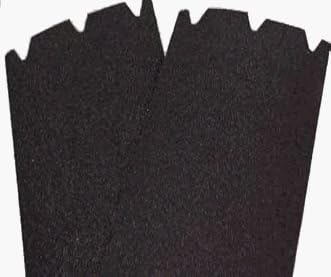
VA 60-grit 8×19-1/2 drum sheets (50-pack)
Second-pass cut. Erases 36-grit scratch pattern.
from ~$116.50 (≈$2.33/sheet, 50-pack · 4.4★)
See 50-pack offers on Amazon →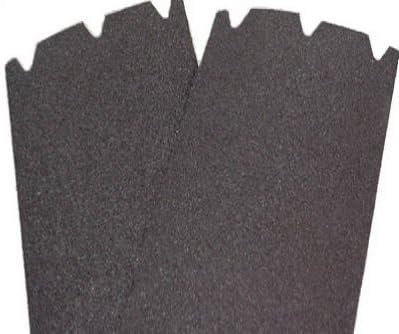
VA 80-grit 8×19-1/2 drum sheets (50-pack)
Workhorse smoothing pass. Run the edger at matching 80 simultaneously.
$70.97 (≈$1.42/sheet, 50-pack · 4.6★)
Buy on Amazon →VA 100-grit 8×19-1/2 drum sheets (50-pack)
Final drum pass for clear poly. For stain or water-based, Norton closed-coat at 100 is the better call.
$89.00 (≈$1.78/sheet, 50-pack · 5.0★)
See 50-pack offers on Amazon →Prices pulled from Amazon at publish; verify before ordering. Amazon Associate disclosure: we earn from qualifying purchases at no extra cost to you.
For machine setup and loading
This article covers the sheets. For the Clarke DU-8 specifically — loading, troubleshooting, rental inspection — see our DU-8 machine guide. For other machines in this size class, see the EZ-8 guide (both versions). For the full refinishing process, see how to sand hardwood floors.
VA for the cut, VA at 100 on Amazon because Norton is not sold there in this size, Norton from a distributor if you want closed coat, ceramic for the hard exotics. Skip closed-coat at 36 grit unless you like changing sheets every 50 sq ft.
Matt.
Frequently Asked Questions
What size sheets fit a Clarke DU-8 drum sander? ▼
8×19.5 inch sheets. This size also fits the Clarke EZ-8 clamping bar version and the Hiretech HT8. The newer EZ-8 expandable drum version uses 8×19 inch belts — a different product.
Which brand actually wins on quality? ▼
Different brands win at different stages. Virginia Abrasives' semi-closed-coat aluminum oxide wins for cut grits (36-80) because it resists loading on old polyurethane. Norton closed-coat wins for the 100-grit finishing pass because the finer scratch pattern looks better under stain or water-based finish. 3M is the middle option.
What is the difference between open coat and closed coat? ▼
Closed coat has abrasive covering 90-100% of the surface — cuts faster but loads sooner. Open coat covers 50-70% with dust-clearance gaps. Semi-closed coat (what Virginia Abrasives uses on its floor line) sits between the two — enough gap to resist loading on old finishes, more grain than open for faster cutting. For most refinish jobs, use a loading-resistant coat (open or semi-closed) through the cut grits and closed-coat for the final pass.
Related Guides
- 80 Grit vs 100 Grit Sandpaper for Floors— 80 vs 100 grit final pass: 100 for water-based or stain, 80 for oil-based clear.…
- Best Sanding Sheets for Clarke DU-8 Drum Sander— Clarke DU-8 sandpaper: 8×19.5 inch sheets. Loading, troubleshooting, rental insp…
- Best Sandpaper for Hardwood Floor Refinishing— Best sandpaper for hardwood floor refinishing: Virginia Abrasives vs Norton vs 3…
- Clarke EZ-8 Sandpaper Size Guide: Both Versions, Specs— Clarke EZ-8 sandpaper: older clamp-bar uses 8×19.5 sheets, newer expandable drum…
- Clarke Super 7R Edger: Specs, Disc Sizes, Variable Speed— Clarke Super 7R edger guide: 7-inch discs, 7/8 vs 5/16 center hole, variable spe…
- Floor Sanding Edger Discs 7-Inch: VA vs Norton vs 3M— Best 7-inch edger discs compared: VA, Norton, 3M by stage. PSA vs hook-and-loop.…
- Drum Marks, Swirl Marks, Scratches: Floor Sanding Fixes— Fix common floor sanding problems including drum marks, swirl marks, and scratch…
- How to Sand Hardwood Floors with a Rental Sander— Sanding hardwood floors with a rental drum sander: NWFA grit sequence, dust and …
- Lagler Hummel Belt Sander: Belt Sizes, When It's Worth It— Lagler Hummel guide: 7-7/8 × 29-1/2 belts, rental inspection, honest when-it-jus…
- Free Sandpaper Grit Chart PDF: Every Grit, Every Material— Printable sandpaper grit chart PDF — which grit for wood, drywall, metal, paint.…
- How Much Sandpaper Do I Need? (Sheet Calculator by Room)— Sandpaper sheet calculator for floor sanding — drum sheet and edger disc counts …
- Sandpaper Types: Aluminum Oxide vs Ceramic vs Zirconia— Aluminum oxide, silicon carbide, ceramic, and zirconia compared. Which abrasive …
- Silverline SL-8 Sandpaper: 8×20-1/8 Size Guide— Silverline SL-8 slotted drum takes 8×20-1/8 sheets; the hook-and-loop drum takes…
- Sandpaper Backing, Bonding & Coating: What They Mean— Beyond grit: how sandpaper backing (paper vs cloth), bonding resin, and open vs …
Shop Virginia Abrasives on Amazon
Drum sander sheets, edger discs, polishing pads, grit kits. U.S. manufactured. Free Prime shipping on most items.
Browse Virginia Abrasives →